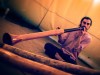
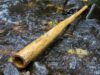
Traditional eucalyptus didgeridoos are hollowed out by termites and sculpted into a playable instrument by a craftsman. This makes each instrument completely unique in sound and playability. Decorating a didgeridoo in the traditional way is also an art form that has many layers of deeper meaning. These 5 authentic Aboriginal Australian instruments have a lot in common and a lot of differences. The best way to compare them is to play them side by side.
Question of the day: What is your preferred type of didgeridoo? Do you like play on eucalyptus, agave, yucca, plastic, hemp, carbon fiber, local hardwoods, or other? Do you prefer authentic Aboriginal Australian instruments? Post your response in the comments section below.
Included in this video are the following five instruments:
Most musicians will, at one time or another, wish to play with others. This might mean hanging around and playing a few tunes in a friend’s living room or it could mean working with a full-fledged band.
Whatever the case, it’s crucial that any musician who wishes to play with others possesses simple listening skills in order to truly add to the music. While these skills are simple, they’re also highly important and effective, making them a great foundation on which to build your musical relationships.
Below are a few areas I find most important when attempting to truly tune in to the music being played, as well as some of my favorite tips for improving your listening skills.
A Tight Sense of Rhythm
Rhythm is the heartbeat of all music. It’s what ensures that a group of musicians remains constantly in sync and it’s one of the most important aspects of any piece you might play. Therefore, it’s very important that every musician, especially those who wish to play in group settings, have a strong sense of rhythm.
If you have trouble finding rhythms and playing to a specific beat (or at a certain speed), be sure to focus on these things during your practise. Some ideas for improving rhythm include clapping out a rhythm before playing it, audibly counting the beats of a song while listening to a recording, and practicing with a metronome.
An Accurate Sense of Pitch
A musician who plays off-pitch won’t be appreciated by his or her bandmates as the results are likely to be less than appealing! For this reason, pitch is yet another skill that simply must be mastered in order for a person to play well in a group.
Fortunately, even if you aren’t born with a perfect sense of pitch, there are ways to attain it. By purchasing a digital tuner, investing some time and effort, and following the steps in the article linked above, you’ll be well on your way to perfected pitch.
The Ability to “Jam”
There are a great number of unspoken rules when it comes to musical jam sessions. Many of these are obvious, such as tuning your instrument, learning before you play so you don’t mess up the song for everyone else, and sticking to the proper genre when choosing songs.
However, some jam session etiquette isn’t quite so obvious. Therefore, I suggest giving this article a read if you’re attending your first meetup.
An Ability to “Talk Music”
Listening to a couple of seasoned musicians speak can sometimes sound like listening to a foreign language. There’s a lot of music lingo out there and it’s important that all musicians learn the jargon in order to communicate effectively.
To get a good handle on this music slang, make an effort to attend jam sessions and other social events involving musicians. This will give you a chance to practise the lingo you do know and learn a bit more to boot.
That said, musical slang can also be learned through the use of online tutorials and forums as well as various music books.
Singing in Tune
Even if your voice isn’t your primary instrument, it’s highly important that every musician knows how to sing in tune. This might seem silly if you play an instrument like saxophone, harmonica, or didgeridoo. However, I have a very good reason for feeling this way.
You see, the voice is the first instrument a person ever uses. It’s also the only instrument that will always be with you no matter where you are and, likely, the instrument you’ll have the easiest time using without any practise when learning a song for the first time.
Finally, singing is the easiest and best way to hone your sense of pitch. All of these things come together and lead me to believe that learning to sing in tune is crucial to the success of any musician, especially one who wishes to play with other music makers.
If you are on a mission to learn to play in a group, I am certain these tips will help you on your way. So what are you waiting for? Get to work! Soon enough, you’ll be playing like a pro alongside musicians of all abilities.
Christopher Sutton is the founder of Musical U, where musicians can discover and develop their natural musicality. Born and raised in London, England, he lives with his wife, daughter, and far too many instruments.
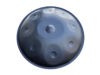
These two RAV drum models, the G Minor Pentatonic and the G Pygmy are similar but different. There is one main note that is different: the flat 6th (b6), which in the key of G is Eb (E-flat), and is also called the “pygmy note”.
Check out the video to hear how these two scales differ and see which one is better for you.
This RAV Vast Comparison was done by Matt Bazgier and the video was edited by Narin Kerim
Aboriginal Australian Artist Lewis Burns is an ambassador of the Aboriginal Tradition and carries the wisdom and knowledge of his elders around the world as he travels and shares his culture. Lewis Burns performs and teaches on didgeridoo at the Tribal Rhythms Gathering in Upstate New York, August 17-20, 2017. Tickets are still available at https://www.didgeproject.com/gathering.
At the Tribal Rhythms Gathering, participants will have the opportunity to study traditional didgeridoo rhythms with Lewis Burns. This video was taken at Didge Project’s Didgeridoo Mountain Retreat, Upstate New York during the summer of 2016.
Learn three different easy to play rhythms for RAV Drum, handpan or any multi-toned percussion instrument. The first two of these rhythms are linear, meaning you only play one note at a time. The third rhythm introduces chords, playing more than one note at a time. Percussionist and multi-instrumentalist Matt Bazgier demonstrates.
***Take lessons with Matt Bazgier via Skype worldwide. Contact mattbazgier@gmail.com.
The RAV Drum played in this video has a G Pygmy scale tuning.
Notes in the G Pygmy scale: G2, C3, D3, Eb3, G3, Bb3, C4, D4, F4
Scale tones (in the same order): 1, 4, 5, b6, 1, b3, 4, 5, b7
RAV Drum (aka RAV Vast) is a relatively new instrument that fuses the concepts behind handpans (hang drums) and tongue drums (traditionally made of wood). Perfectly cut steel tongues vibrate harmoniously together to create an ethereal sound perfect for meditation, relaxation, and other mystical music experiences.
RAV was invented in 2013, the same year PanArt stopped making the Hang. RAV is from Russia with cut keys as opposed to the hammer tuned Hang drum, which is not cut or welded in anyway. The RAV has a deep resonance and profound reverb effect where the sound lasts for a long time while the Hang drum sound goes for a much shorter duration. This allows for a lot more space between key strokes in the RAV because the sound carries so long without losing the rhythm, which can make for more experimental playing in some respects than the Hang or handpan. The fullness of the sound and the duration of each key stroke makes the instrument very meditative to play because it renders itself to slow playing but of course can also be played very quickly and rhythmically. The backside is not as accessible or resonant as a handpan but can still be played rhythmically. The price of a RAV is 1/3 the cost of a Hang and is also generally easier to play than the Hang for most people. It is also a much more durable and sturdy instrument. The handpan can be knocked out of tune with too hard of a hit and over time may need to get tuned up regardless while the Rav does not and is almost impossible to knock out of tune. The Rav also has harmonics beyond the fundamental key like the Hang/handpan and both are available through Didge Project for purchase at https://www.didgeproject.com/store.
In this RAV drum rhythm tutorial, we use the RAV Vast2 C Golden Gate to demonstrate a simple pattern that will sound great on any handpan or RAV drum. Starting at the highest note of the scale, you will play a sequence of 4 descending notes and repeat this 4 times. Then you will start the next phrase on the second highest note, descending 4 notes from there and repeating 4 times. This goes on a few times until you get to the tonic (C4 in this example), and then you repeat the whole verse again. Watch and learn!
The RAV Drum played in this video has a C Golden Gate Scale tuning. This scale is unique because it starts with a C major 7 arpeggio (1 3 5 7 or C E G B) and then goes into a lydian sound featuring the sharp 4th (F#). This is a bright sound that is great for yoga classes, meditation, and deep personal practice.
Notes in the Golden Gate scale: C3, E3, G3, B3, C4, D4, F#4, G4, B4
Scale tones (in the same order): 1, 3, 5, 7, 1, 2, #4, 5, 7
RAV Drum (aka RAV Vast) is a relatively new instrument that fuses the concepts behind handpans (hang drums) and tongue drums (traditionally made of wood). Perfectly cut steel tongues vibrate harmoniously together to create an ethereal sound perfect for meditation, relaxation, and other mystical music experiences.
RAV was invented in 2013, the same year PanArt stopped making the Hang. RAV is from Russia with cut keys as opposed to the hammer tuned Hang drum, which is not cut or welded in anyway. The RAV has a deep resonance and profound reverb effect where the sound lasts for a long time while the Hang drum sound goes for a much shorter duration. This allows for a lot more space between key strokes in the RAV because the sound carries so long without losing the rhythm, which can make for more experimental playing in some respects than the Hang or handpan. The fullness of the sound and the duration of each key stroke makes the instrument very meditative to play because it renders itself to slow playing but of course can also be played very quickly and rhythmically. The backside is not as accessible or resonant as a handpan but can still be played rhythmically. The price of a RAV is 1/3 the cost of a Hang and is also generally easier to play than the Hang for most people. It is also a much more durable and sturdy instrument. The handpan can be knocked out of tune with too hard of a hit and over time may need to get tuned up regardless while the Rav does not and is almost impossible to knock out of tune. The Rav also has harmonics beyond the fundamental key like the Hang/handpan and both are available through Didge Project for purchase at https://www.didgeproject.com/store.
According to the National Sleep Foundation, approximately 18 million Americans suffer from sleep apnea, while many don’t even know that they have it. Watch the video above to see testimonials from real people who have mitigated sleep apnea by playing the didgeridoo.
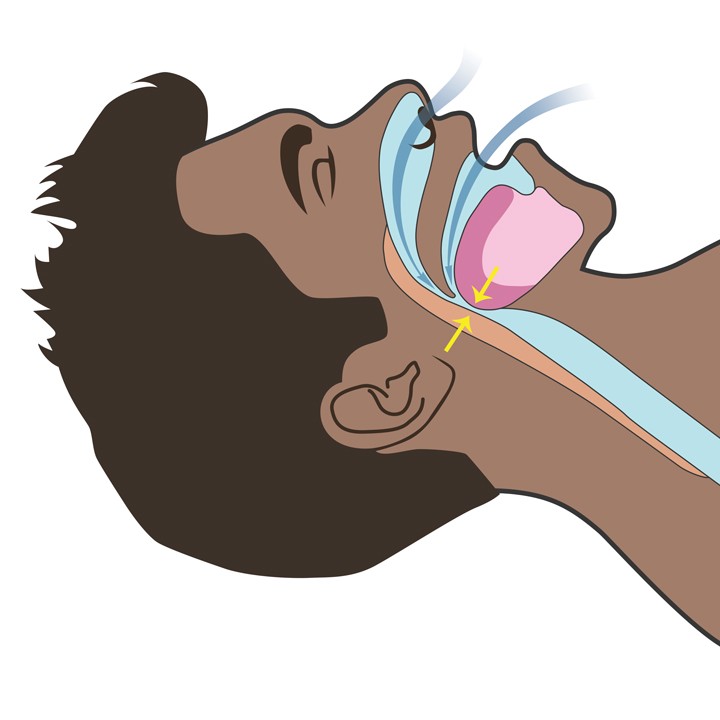
Compression of the airway during an apnea event.
Sleep apnea is a condition in which the airway between the nose and lungs is blocked, causing interruption of sleep and low energy levels throughout the day. People diagnosed with sleep apnea are often prescribed a range of treatment options, most often CPAP (continuous positive airway pressure) devices and surgeries. Now there’s a natural way to help with breathing at night: a study published by the British Medical Journal indicates that playing the didgeridoo can make a difference.
How can playing a wind instrument improve sleep?
By strengthening the muscles of the throat and tongue, didgeridoo playing helps to maintain an open airway during sleep and prevent airway blockages. Just as a person strengthens the major muscles of the body by lifting weights, playing the didgeridoo strengthens the muscles in the windpipe, thereby reducing the chance of obstructed breathing during sleep.
When can users expect results?
The clinical study indicates that after 3 months of daily practice, many people experience significant improvements in their breathing during sleep and lowered incidence of fatigue during the day. Didge For Sleep is an easy to follow step-by-step method that can be done in the comfort of the home.
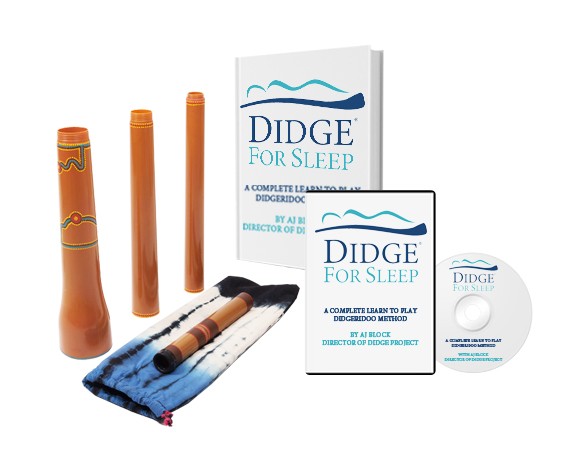
The Didge For Sleep Introductory Package is specifically designed as a solution for people with sleep apnea, snoring, and other sleep-breathing conditions. Each package comes with a travel didgeridoo, an instructional DVD (also streamable online), a handbook (also downloadable as an eBook), and an online support forum where users can connect with a community of people using the didgeridoo for better sleep. Additionally, users receive over 10 hours of video tutorials.
Get started with your Didge For Sleep Introductory Package today. Visit us at www.didgeforsleep.com.
On July 1, 2017 a group of 20 didgeridoo players gathered in New York City for Didge Project’s annual free event: The Central Park Didgeridoo Gathering. Participants were introduced to a number of new rhythms and playing techniques and practiced playing in a “rhythm circle,” as shown in the video. The Central Park Didgeridoo Gathering serves to build community, to connect people and to provide space for group music making. Thank you to everyone who came and supported this event.
Follow Didge Project on Facebook: https://www.facebook.com/didgeproject
Subscribe to Didge Project on YouTube: https://www.youtube.com/didgeproject7
Visit https://www.didgeproject.com for the latest tutorials, events, interviews and more
Special thanks to the volunteers:
Narin Kerim – video camera
The Magic of the Didgeridoo is an interactive presentation with Didge Project’s AJ Block that gets students clapping, singing, dancing and making lots of didgeridoo sounds. Buzzing the lips, breathing in different rhythms and imitating the “animal sounds” of the didgeridoo are a few of the many engaging techniques students experience.
Included in this presentation is a background of the Aboriginal Australian culture surrounding the didgeridoo and how the instrument is created. The original didgeridoos were eucalyptus logs hollowed out by termites, and students receive a vivid picture of what this is like.
In addition to The Magic of the Didgeridoo, Didge Project offers Make and Play Didgeridoo Workshops for students, who will create, learn to play, and take home their very own plastic didgeridoo.
Book The Magic of the Didgeridoo and other activities for your school, library, community center, camp or youth group by writing to info@didgeproject.com or calling 347-871-3866.
DIDGERIDOO MAKING WORKSHOP WITH LEWIS BURNS ON SUN., AUG. 20.
UPSTATE NEW YORK (2 HOURS FROM NEW YORK CITY)
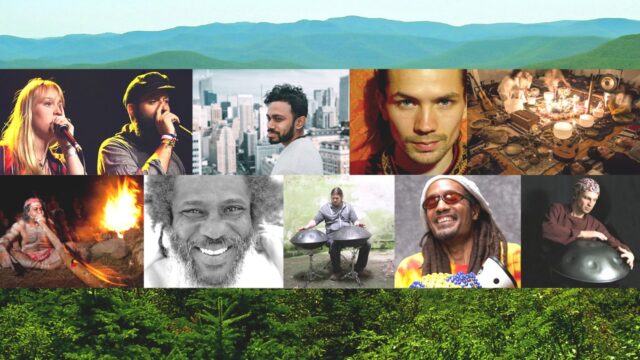
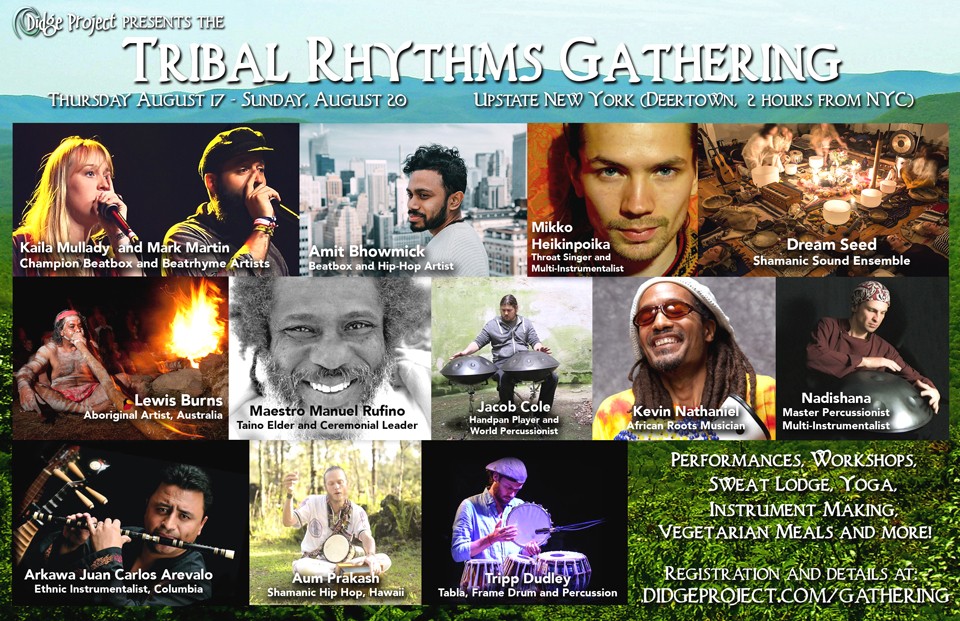
Welcome to The Tribal Rhythms Gathering, a camp-out retreat in the woods with musical masters in the fields of didgeridoo, percussion, Tuvan throat singing, traditional African rhythms, handpan, beatboxing, live looping, and much more. This year’s gathering will feature international artists: Nadishana (Siberia), Lewis Burns (Tubba-Gah Wiradjuri, Australia), Mikko Heikinpoika (Finland), along with Maestro Manuel Rufino (Taino, Dominican Republic), Kevin Nathaniel, Kaila Mullady, Mark Martin, Amit Bhomwick, Jacob Cole, and Dream Seed. Participants will experience the mastery and magic of world-renowned musicians such as Nadishana, who plays over 200 instruments, many of which he has invented along with the opportunity to experience a traditional healing sweat lodge with Taino elder, Maestro Manuel Rufino and hear the teachings and stories surrounding the didgeridoo as shared by aboriginal elder, Lewis Burns. Prepare yourself for a mesmerizing gathering of global culture, world-class music, workshops, and ancient shamanic wisdom.
Watch our Presenter Reel:
DETAILS
Accomodations: There is camping available for free on site. Hotels are available 20-minutes away. All participants who are camping must provide their own tents, sleeping pads and sleeping bags. We will send you information on the nearest hotels as soon as you register.
Food: Vegetarian meals will be provided throughout the retreat. Meals include Thursday dinner, all meals for Friday and Saturday, and Sunday breakfast and lunch. We guarantee you will feel satisfied with quality food prepared by quality people.
Location: This event is being held on private land upstate New York (2 hours driving from New York City). The exact location will be given upon registration.
Arrival/Departure: Activities begin the night of Thursday, August 17 at 7pm with dinner and opening ceremony. Activities will end on Sunday, August 20 at 5pm.
Parking: Parking is available on site and we encourage carpooling as much as possible. Please let us know where you will be coming from and if you would be able to bring additional people in your vehicle.
Public Transportation: Shuttles can be arranged to and from the event site and nearby towns. We will send you the best transit options via email as soon as you register and will help you find the best option.
What to Bring:
Tent
Sleeping Bag
Sleeping Pad/Camping Mattress
Pillow
Clothing
Sweat Lodge outfit (bathing suit or sweat lodge dress)
Bug Spray
Rain Gear (just in case)
Waterproof boots or hiking boots
Didgeridoo (we can provide instruments upon request)
Other musical instruments (optional)
Yoga Mat or blankets for sitting outdoors
Comfortable long pants and long sleeve shirt
Jacket (it may get cold at night)
Towel
Flashlight
TICKETS
Ticket cost is $397 for a full event pass. This price includes meals, accomodations, workshops, sweat lodge, concerts and all activities Friday through Sunday. This price does not include the didgeridoo making workshop, details of which you will find below.
Ticket cost is $150 for a 1-day pass. This includes 3 meals and all event activities during a 24-hour period.
BONUS EVENT: DIDGERIDOO MAKING WORKSHOP
Sunday, August 20
Join Lewis Burns in making your own didgeridoo from a Termite Hollowed Mallee Eucalyptus tree that comes from Australia. This workshop is limited to 5 people and costs an additional $347. Bring your own gloves!
Workshop includes:
1 log, harvested from the Australian outback near Dubbo.
Instructions and guidance on how to de-bark the log, shape the mouthpiece, work on the base and permanently fix any small hairline cracks (if any) and permanently plug any small holes from broken off twigs (if any).
Didgeridoo Painting
Meals for the entire day
Retreat + Didgeridoo Making Workshop cost is $694 and includes includes meals, accomodations, workshops, sweat lodge, concerts and all activities Friday through Monday.
Didgeridoo Making is limited to 5 participants! There will be other workshops happening concurrently for all other attendees.
BUY TICKETS HERE
Space is limited. Sign up now to reserve your spot!
Lewis Burns is a Tubba-Gah Wiradjuri man born and living in Dubbo, NSW Australia. He has been learning about his Aboriginal culture for as long as he can remember. He continues to practice and respect these life skills each day and still learns and grows from this ancient knowledge. Lewis’ love of his heritage is evident when you speak with him, and depicted even more in his Aboriginal crafts, traditional dancing, didgeridoo performances, mural paintings and teaching. He is very dedicated to sharing what he knows with others to help keep these customs alive. Lewis paints in traditional Aboriginal and contemporary styles. He has exhibited globally and performed globally with his handcrafted didgeridoos. Each piece of Lewis’ artwork tells a story…..a story that will live on forever through the generations, as the artwork is handed down from one family to another.
Maestro Manuel Rufino
Maestro Manuel Rufino is a recognized elder in the Taino tradition and World Director of M.A.I.S.C. He is a spiritual guide, gifted ceremonial leader and teacher of sacred initiatic traditions of the world. Maestro Manuel is also an artist, certified iridologist, naturo-therapist, vegetarian chef & the visionary guiding the Golden Drum community and many vegetarian restaurants including Jungle Café in Brooklyn. Guided by his teacher, Maestro Domingo Dias Porta, Maestro Manuel has been following the trails of indigenous healing arts for over 40 years. Maestro Manuel travels around the world sharing initiatic traditions, leading workshops, lectures, sweat lodges and healing rituals.
In 2010 Maestro Manuel and a number of his students opened Golden Drum as a space for sacred traditions in New York City. Founded to give voice to the worldview of Native Americans, indigenous peoples and the esoteric schools, Golden Drum features living representatives and students of these great traditions.
Nadishana
Nadishana is a multi-instrumentalist, composer and sound designer from Siberia, who creates his own unique and innovative approach to world fusion music – the creative synthesis of different musical traditions of the world on the basis of contemporary technologies. He plays on more than 200 instruments of the world, including self-created ones.
He elaborated the unique playing technique on each of his instruments and his own approach to advanced digital audio editing called “sound microsurgery”.
In April 2008, the music of Nadishana was used for the choreography at The Bolshoi Theater (Moscow, Russia). In 2012, Kuckhermann-Nadishana Duo was invited to be the opening act for the Dead Can Dance concerts in Europe, Turkey, and Russia.
Mikko Heikinpoika
https://www.youtube.com/watch?v=jibTAUodMT8
Mikko combines modern trip-hop, dub step rhythms, and cutting edge organic bass sounds combined with ancient ritual-like singing to create a unique mergence of archaic and futuristic music. Mikko has travelled through Tuva and Mongolia where he has taken part in various throat singing ceremonies with the world’s throat singing masters. In the Summer of 2015, he won third prize of the modern category in the style of the “Khoomey” at the Throat Singing Festival held in Tuva.
Kaila Mullady & Mark Martin
Kaila Mullady is a New York based performer – The 2015 World Beatbox Champion, the current America Vice Beatbox Champion, Loop station champion and three time, reigning Beatrhyme Champion. Kaila performs all over NYC and the country infusing beatboxing, singing, rapping, poetry and theater to push the boundaries of creativity and show just what the human instrument is capable of.
She is a multi-instrumentalist, using a RC 300 she is able to loop guitar, beatboxing and vocals to become a one woman band. One half of the Adventures of Kaila and the Kid and part of NYC’s premier freestyle comedy rap group North Coast, incorporating improv comedy and hip hop. Teaching workshops all across the country promoting reading, writing and finding your own soul music. Giving back to communities and volunteering is a big part of Kaila’s creative process.
Mark Martin (aka Mandibul) is a musician and an actor, and has been beatboxing since age 13, inspired by the Jazz, Rock, and Hip Hop music scene around him. He graduated from NYU in 2011 where he studied the linguistics of beatboxing, generating a body of work which informs the use of “beatrhyming” in Beat Rockers classrooms. In 2016, he became the American National Beatbox Champion.
Dream Seed
Dream Seed is a two-hour sound bath hosted by members of Golden Drum and Didge Project. Shamanic chanting, mantras, overtone singing, Native American songs, indigenous music, didgeridoos, crystal singing bowls, bells, gongs, harmoniums, tuning forks and other overtone-emitting instruments are used to create an environment conducive to deep relaxation and inward investigation. Participants are led through guided meditations and sound healing practices designed to harmonize body, mind and spirit.
Jacob Cole
Jacob Cole has been playing the drums since the age of 7 and studied percussion at Berklee College of Music. Jacob studied under Jamy Haddad, the percussionist for Paul Simon, who taught him the frame drum, udu, and kanjira. He has also studied with with tabla master, Ustad Zakir Hussain. Jacob is currently most known for his handpan music and world percussion blending. The handpan is a new generation of hand hammered steel instruments which came from the original inspiration called the Hang, invented in Switzerland in 2000. Handpans are now made all over the world, but they remain very rare.
Kevin Nathaniel
Kevin Nathaniel Hylton graduated Yale University in 1982 as Scholar of the House for fine arts. He has since devoted himself to music – African music in particular. He performs on several traditional African instruments and builds them as well. He is founding member of four music groups, Spirit Ensemble, Heritage O P, Forestdance, and Kaleidhaphonic, all of which currently perform in NYC and internationally. Kevin is a known composer of African-inspired contemporary music. He writes songs, lyrics, poetry, and essays on music and instruments. He has composed and recorded for the audio version of Alice Walker’s Possessing the Secret of Joy, for the film Beloved, as well as several documentaries. His workshops and lecture/demos have been presented at Lincoln Center, Juilliard, University of Michigan, Wesleyan University, and several other institutions. In 2005 he and Hasan Bakr were commissioned by Carnegie Hall to write and direct the fall Family Concert titled “DIndinyaa”. With Symphony Space he has helped create a program for African music that visits NYC schools and produces a concert every December. As an advocate for African culture he has been called the “Johnny Appleseed” of the mbira because he has taught tens of thousands of people all over the world the art of mbira making and playing.
Amit Bhowmick
Amit is one of the top beatboxers in the United States, competing in the final rounds of the American Beatbox Championships in 2013, and winning the Midwest Beatbox Battle in 2012 and beating current Grand Beatbox Champion, Kenny Urban, in 2014 at the East Coast Beatbox Battle. Amit has since come together with the top beatboxers in the United States to create the Beatbox House, a beatbox collective based in New York City that tours the world competing, teaching, and blowing minds with the magic of beatboxing.
Aum Prakash
Aum Prakash has traveled the world(s) as a healer and musician spreading positive vibrations to raise consciousness and unite humanity. He brings together sacred world music, healing songs, and conscious hip hop to bridge the ancient and the modern, inspiring an awareness of the sacred and an embodiment of the ceremony. Aum is a student of Maestro Manuel Rufino and lives in Hawaii. Aside from making music, his passions are sacred healing arts and adventuring with his wife OmniLove and daughter Makani.
Tripp Dudley
Tripp Dudley is a drummer, tabla player and percussionist based out of Brooklyn, NY. His deep groove and virtuosity across multiple instruments have paved the way for his many journeys around the world with many different musicians.
At the age of 10 he started playing guitar, and not long after that he began playing classical percussion with his school band. He soon learned how to play drum set and then started the all day playing sessions that would fill his life for many years to come.
At 20 Tripp began attending Berklee College of Music, specializing in drum set performance and frame drums. He quickly started studying Indian rhythmic systems which began a very big part of his future path through music. At 22 he started playing tabla, which has been at the core of his musical practice ever since.
Tripp moved to New York City in 2007 to pursue his journey into the professional musical world. During his years in New York, Tripp worked with musicians from many different genres – prog-rock/metal, hip hop, funk, jazz, singer-songwriter, Indian classical, many different world-fusion groups and even the occasional off-Broadway musical. In 2009 he met his Guruji, tabla maestro Pandit Samir Chatterjee.
Tripp currently tours the world over with many different artists. When not on tour he splits his time in the magical bustle of New York. He remains a disciple of Pandit Samir Chatterjee.
Some of the artists that Tripp has shared the stage and recorded with are: Simrit, Jai Jagdeesh, Bolé, Beth Nielsen Chapman, Snatam Kaur, PHWG, Mirabai Ceiba, Pandit Samir Chatterjee, Dan Weiss, Ezra Landis, Shannon Hayden, Jared May, Maartin Allcock, John Ragusa, Kevin Nathaniel, Salieu Suso, Salif Bamakora, Adam Rudolph’s GO: Organic Orchestra, Matthew Schoening, The Guruganesha Band, Copal, Letha, Highly Kind, and Tablaphilia, to name a few. He also has his own Afro-Indian fusion project called Kaleidhaphonic.
Arkawa Juan Carlos Arévalo
ARKAWA (JUAN CARLOS AREVALO) is an indigenous multi-instrumentalist, producer, composer and arranger from the town of Pastos, Columbia. More than 25 years of exploration of ethnic music of the world serve as the foundation for Arkawa’s music. Mr. Arevalo has represented his country in international music competitions and at the World Championship of the Arts in Los Angeles, CA won Silver Medal for Best Original Work
DON’T MISS THIS EVENT
Space is limited. Sign up now to reserve your spot!
Tickets cost $397 for a full event pass OR $150 for a 1-day pass.

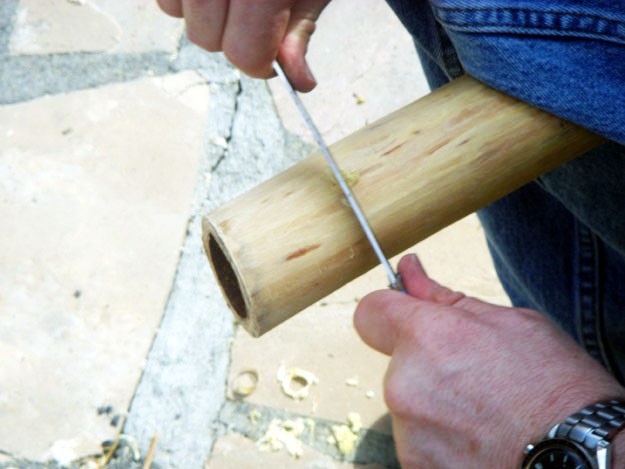 Join Lewis Burns in making your own didgeridoo from a Termite Hollowed Mallee Eucalyptus tree that comes from Australia. This workshop is limited to 5 people and costs an additional $347. Bring your own gloves!